Omega was innovating long before the Moonwatch
Decades before space exploration, Omega was forging new paths for watchmaking with unbeatable precision and a mass-production mindset
By Rachael Taylor
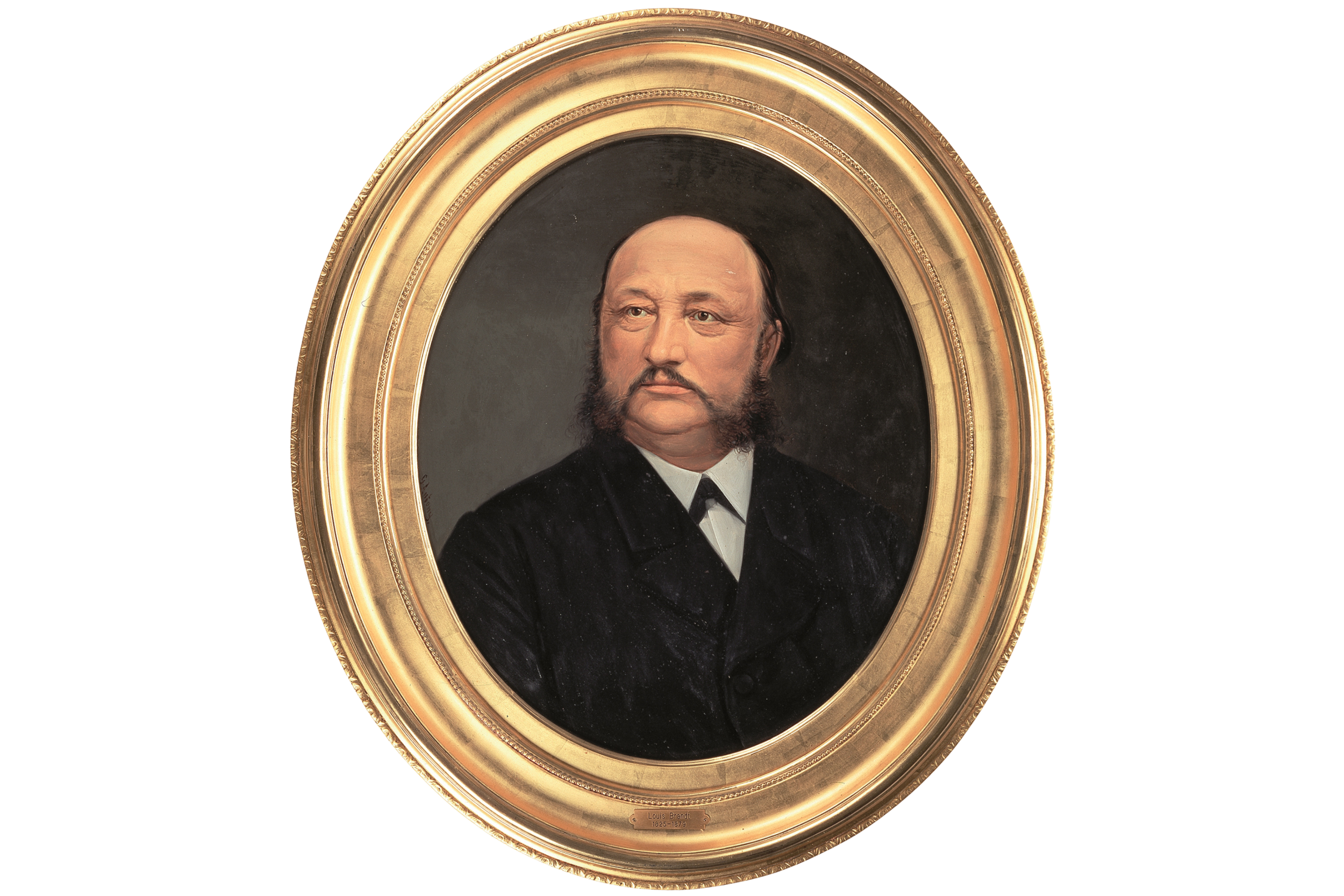
To understand the origin story of Omega, we must travel back in time to 19th-century Switzerland and the town of La Chaux-de-Fonds, nestled high in the Jura Mountains. It was here, in 1848, that a 23-year-old watchmaker named Louis Brandt set up a modest workshop. And in doing so, laid the foundation for one of today’s most famous and loved watch brands, Omega.
At the time, La Chaux-de-Fonds was already a vibrant hub of horology. Its distinctive grid-like layout – the result of the town being partially rebuilt after a fire in 1794 – was designed to maximise light in the buildings. It was an architectural rarity in Switzerland, and the purpose-built roads and buildings that emerged after the fire made it ideal for housing crafts that required a keen eye, such as watchmaking.
Brandt joined a growing number of industrious craftsmen in La Chaux-de-Fonds, and began assembling key-wound pocket watches using parts supplied by local producers. These early watches were manually wound with a key, which was the standard at that time, before the widespread adoption of the stem-winding mechanism.
Brandt was passionate about precision, and within a few years the young watchmaker cultivated a reputation for delivering highly accurate timepieces. His horological renown spread, first through Switzerland and then beyond. Historical records show that Brandt would travel personally to visit clients in Italy, Scandinavia and England.

A map of La Chaux-de-Fonds, drawn by Charles-Henri Junod in 1841. (Image: Wikimedia Commons)
Establishing Louis Brandt & Fils
As Brandt’s business grew, his sons Louis-Paul and César Brandt joined him, and the company name of Louis Brandt & Fils was registered in 1877. Brandt would pass away just two years later, but his sons carried on the family business led it to new heights.
Despite the loss of its founder, Louis Brandt & Fils was thriving, and the brothers realised they needed more space than the workshop in La Chaux-de-Fonds could afford. So, in 1880 they made a bold move to change location, setting up 45km away in Bienne. Their first address was 119 Route de Boujean, before moving to 96 Rue Jakob-Stämpfli – which remains the address of Omega today.
Not only did this new town offer more space to grow, it also had better transport links and hydro-powered factories. It was also home to a glut of suppliers and manufacturers for Louis Brandt & Fils to source from, and a workforce that was better suited to factory-based manufacturing than the artisanal cottage industry model they had left behind in La Chaux-de-Fonds.

An 1850 postcard of the Grand Hôtel Macolin in Bienne. (Image: Bibliothèque nationale de France, département Société de Géographie)
An early pioneer of integrated manufacturing
This move marked a crucial turning point, allowing the brothers to modernise their business. While Louis Brandt & Fils maintained the family commitment to quality, the next generation were determined to shift away from the traditional établissage – artisanal – system of watchmaking in which parts are sourced from different suppliers and assembled piecemeal. Instead, the Brandt brothers introduced an integrated manufacturing model, aiming to bring as many processes as possible under one roof. This allowed for greater consistency, faster production, and, ultimately, more innovation.
Under this new set up Omega was producing watch movements in larger quantities by using standardised rather than individually handcrafted parts, meaning each one could be assembled more quickly and more reliably. This led to the creation of their first series-produced calibre in 1885, which they called Labrador.
The Labrador movement marked a major technological leap forward, delivering exceptional accuracy and build quality for its time. It was the company’s first real step toward large-scale, standardised watchmaking. With the Labrador, Omega showed the world that precision could go hand in hand with efficient production – an ethos that would define the brand’s future.

An advert for Louis Brandt & Frère, ‘manufacturer of Labrador watches’. (Image: Omega)
How Omega got its name
More innovation followed. In 1892, the Brandt brothers collaborated with watchmaker Audemars Piguet to create what is thought to be the world’s first minute-repeating wristwatch. A minute repeater is a highly complex mechanical complication that chimes the hours, quarters, and minutes on demand, allowing the time to be heard as well as seen. It was a useful function for the days before widespread electric lighting, but was still charming in the late 19th century, by which time many homes had introduced this innovation.
This groundbreaking one-of-a-kind watch (only one was ever produced) is somewhat unassuming considering its landmark horological prowess. It has an unbranded white enamel dial, with a seconds sub dial, looped by an 18-karat gold case on a leather strap. You can see it for yourself in the Omega Museum in Biel/Bienne, as the town is now known after a 2005 decision to merge the German and French names for the bi-lingual city.
In 1894, Louis Brandt & Fils revealed another innovation: its 19-ligne pocket watch calibre, which would change the course of the business, and the wider watchmaking industry. The calibre was named for its size – a ligne is an old French unit used specifically in horology to measure the diameter of watch movements, with 19 ligne the equivalent to about 43 millimetres. The 19-ligne calibre was highly accurate, easy to repair, and designed with industrial-scale manufacturing in mind. For the first time, every component of the movement could be replaced without the need for custom fitting – a revolutionary idea in an era when most timepieces were still handmade.
The 19-ligne was so successful that the brothers gave it a name: Omega. Named after the final letter of the Greek alphabet, it symbolised perfection and completion. The name caught on so quickly, and sales of the Omega calibre were so strong, that Louis Brandt & Fils rebranded that same year to Omega Watch Co to capitalise on its popularity. The following year, in 1895, Omega debuted its first official brand imagery, an illustration of Chronos – the Greek god of time – atop a globe inscribed with the Omega name, and holding a pocket watch and pointing a lance to the brand name. It was a powerful symbol of Omega’s global ambitions.

An 1984 poster advertising a pocket watch with the 19-ligne calibre, and the new Omega branding. (Image: Omega)
Early global expansion
At a time when globalisation was still in its infancy, Omega was exporting timepieces to markets as far afield as the United States, China, and South America. It was also winning critical acclaim, receiving the Grand Prize at the 1900 Universal Exposition in Paris in recognition of its advancements in horology.
It was one of the first Swiss watchmakers to operate as a true international brand, supported by a reliable production system that could deliver high volumes without compromising on quality. Retailers across the globe advertised carrying the world-famous Omega watches to draw in customers. At G and T Young in Oamaru, New Zealand, in 1903 – by which time Omega was the largest manufacturer of finished watches in Switzerland – you could buy one for 26 shillings. By 1909, Omega was selling on six continents.
The business was going great guns, until the global financial crash of 1929 hit the Swiss watch industry hard. In an attempt to strengthen its position, Omega formed an alliance with fellow Swiss watch brand Tissot. In 1930, the two companies merged to form SSIH (Société Suisse pour l’Industrie Horlogère) to share resources and research.

An H. Meyer illustration of the 1900 Universal Exposition in Paris, at which Omega was awarded a Grand Prize for innovation. (Image: Wikimedia Commons)
A switch to wristwatches
In the early decades of the 20th century, Omega began to create a number of associations that would raise the profile of the brand. It became a supplier to the military as well as the railway. It also started to align itself with sporting events, which would prove to be a particularly savvy move. In 1932, Omega was chosen as the official timekeeper of the Olympic Games – a title it holds to this day.
Throughout this period, Omega also played a crucial role in the evolution of wristwatches. Like many early wristwatch manufacturers, it answered the early 20th century trend for watches by adapting pocket watch movements to be worn on the wrist. But soon it started designing movements and cases specifically for this smaller, more wearable format.
One of Omega’s most notable early wristwatches was worn by British Royal Flying Corps pilots in World War I, and had a robust design and legible dial that proved ideal for military use. For many soldiers, war was the first time they had worn a timepiece on the wrist, as it was previously deemed a woman’s object, as they had no pockets in which to place a pocket watch. The mandated wristwatch for men, which was much more practical than a pocket watch during the trials of war, sparked a post-war trend as men grew used to the design.

A 1932 advert for Omega wristwatches and pocket watches that highlights its links to the Olympics. (Image: Wikimedia Commons)
A burst of innovation in the 1930s
Post war, Omega focused on improving precision, and in 1931 its chronometers set new records in all six categories of the Geneva Observatory trials. Doing so meant the timepieces were more accurate across a range of conditions than any other watch tested at that time.
Omega would follow this with a world precision record in 1936, when an Omega calibre scored an extraordinary 97.8 out of 100 at the Kew Observatory – a result so precise it remains unbeaten to this day.
The 1930s were a period of much innovation for Omega. In 1931, it pioneered a groundbreaking automatic movement prototype that used two weights to wind the mechanism in both directions – a leap in efficiency that laid the foundation for the modern self–winding watches we know today. Then, a year later, it launched the Marine, the world’s first commercially available divers’ watch. The Marine featuring a patented double case sealed with cork to protect against water seeping inside, and had an adjustable clasp with a divers’ extension.
This – and other innovations introduced by Omega – would prove valuable when World War II broke out across Europe at the end of the decade.
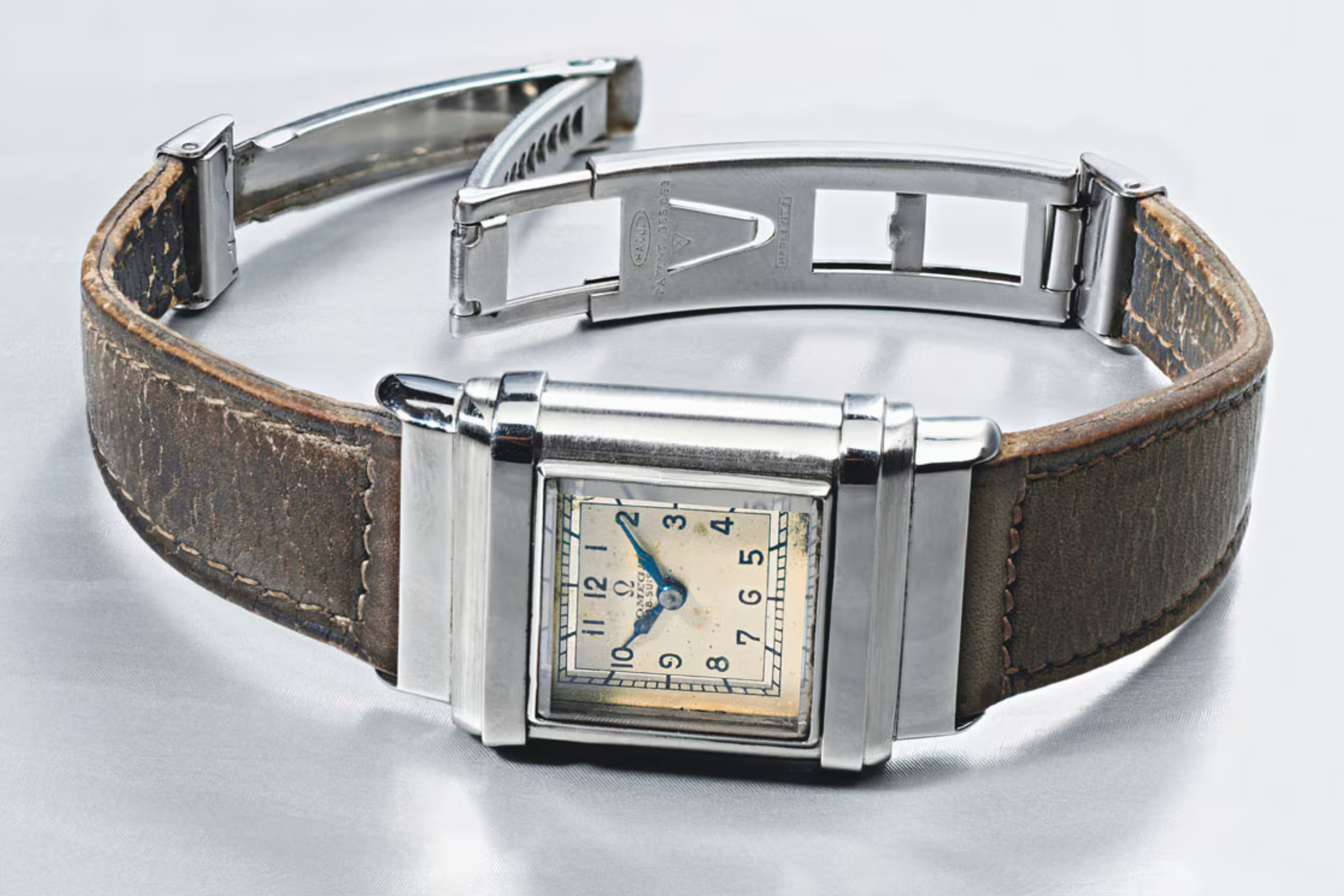
An Omega Marine watch from 1932. (Image: Omega)
This article is an edited extract from the book Omega: The Story Behind the Style by Rachael Taylor, published by Studio Press
Main image: A portrait of Louis Brandt. (Image: Omega)